✓ Instant Digital Download✓ No Account Required✓ 100% Money-Back Guarantee
WEC Practical Guide 08 — How to Conduct a Functional Behavioral Assessment
WEC Practical Guide 08 — How to Conduct a Functional Behavioral Assessment
Couldn't load pickup availability
A functional behavioral assessment should be more than a form. It should be a disciplined process for defining behavior precisely, gathering meaningful evidence, identifying patterns, developing a defensible functional hypothesis, and using that hypothesis to design more effective support.
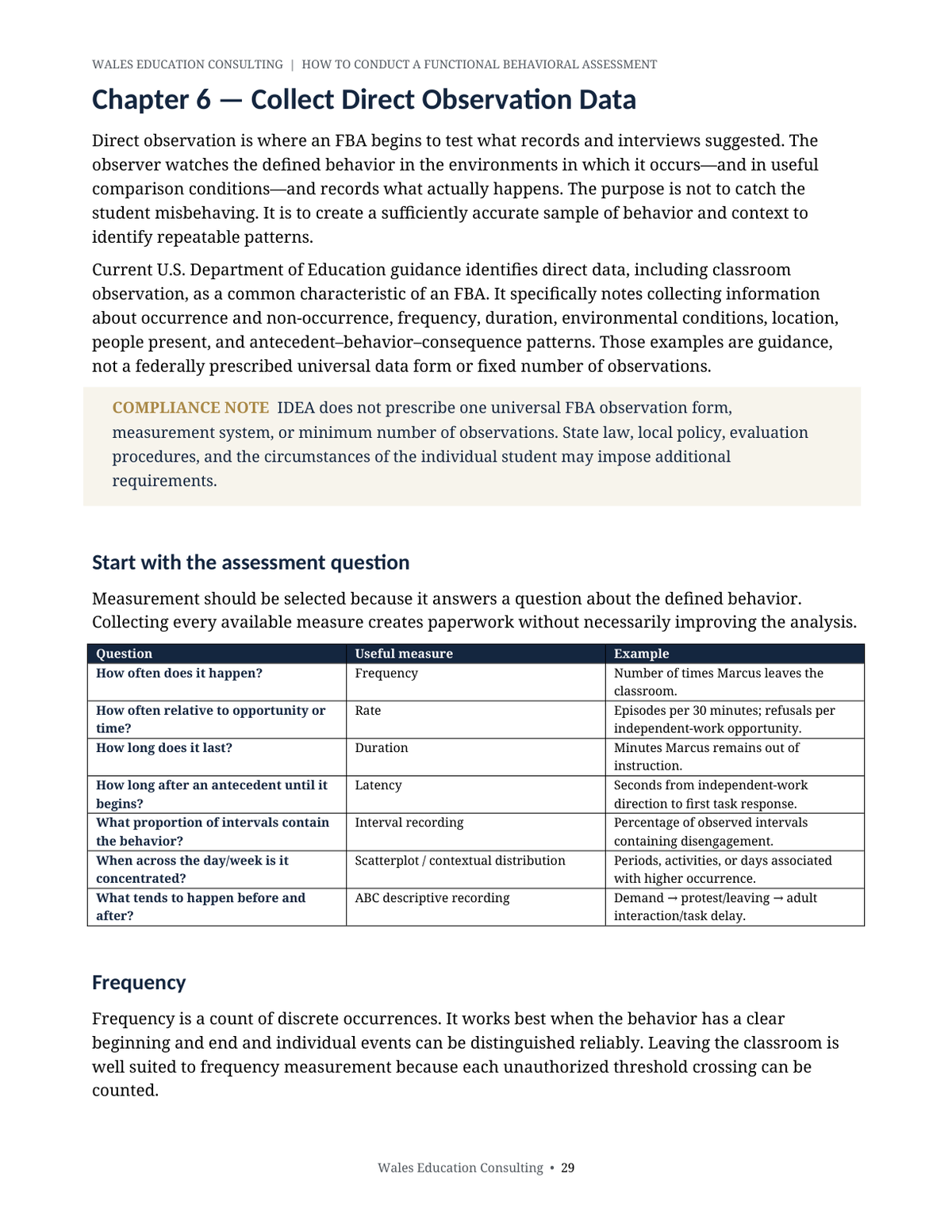
How to Conduct a Functional Behavioral Assessment gives school professionals a practical framework for carrying out that process in real educational settings. The guide distinguishes an FBA from informal observation, discipline investigation, behavior screening, and a behavior intervention plan; explains how to select and use direct-observation measures; shows how to analyze antecedents, consequences, setting events, and competing hypotheses; and demonstrates how to write a clear FBA report without overstating what descriptive data can prove.
A running fictional case follows Marcus Reed, a seventh-grade student, from the initial concern through operational definitions, records review, interviews, direct observations, ABC analysis, competing hypotheses, the final functional hypothesis, the written FBA, and translation into a function-based BIP framework.
The guide includes 27 practitioner tools for planning, interviewing, direct observation, measurement, pattern analysis, hypothesis development, reporting, FBA-to-BIP alignment, and progress monitoring. Legal and professional boundaries are identified throughout so readers can distinguish federal requirements from federal guidance, recognized professional practice, and state or local procedures.
Share